


Onam: When Kerala Comes Together
Some festivals can be understood through photographs and videos. Onam is not one of them.
To understand Onam, you have to be in Kerala when doorsteps begin to bloom with flowers, kitchens grow busier by the hour, new clothes emerge from cupboards and families find their way back to one another.
For Malayalis, Onam is more than a date on the calendar. It is a season of homecoming.
Those living away often plan their journeys around it, returning to familiar faces, family traditions and a meal they have been thinking about long before they arrive. In many ways, the journey home is as much a part of Onam as the celebration itself.
Celebrated during the Malayalam month of Chingam and traditionally associated with the harvest season, Onam is closely linked to the story of King Mahabali. Remembered as a beloved ruler whose reign represented happiness, equality and prosperity, Mahabali is believed to return to Kerala each year during Onam to visit his people.
And Kerala prepares to welcome him.
A Welcome Made with Flowers
The first signs often appear at the doorstep.
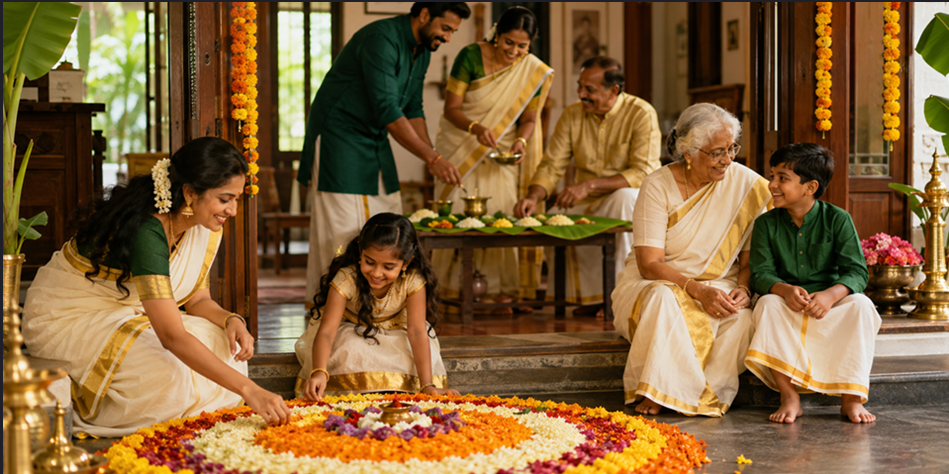
Pookalams-intricate floral arrangements, begin appearing outside homes, schools, offices and public spaces. What may start as a simple pattern gradually becomes more elaborate as the days of the festival unfold.
Yet the beauty of a pookalam lies as much in its making as in the finished design.
Children gather flowers. Someone takes charge of the pattern. Someone else inevitably suggests changing it halfway through. There are opinions, corrections, laughter and the occasional disagreement over where the next colour should go.
By the time it is complete, the pookalam has become more than decoration. It is something made together.
For travellers in Kerala during Onam, these colourful entrances offer an immediate glimpse into the spirit of the season. No two look exactly alike, yet everyone seems to say the same thing: welcome.
New Clothes, Familiar Faces
Onam is also an occasion to dress for the celebration.
Women often wear the elegant cream-and-gold kasavu saree, while men may choose a traditional mundu paired with a shirt or kurta. Children eagerly await their Onakkodi, the new clothes traditionally given for the festival.
Soon, family photographs begin. Relatives arrive. Conversations stretch longer than usual.
Every household has its own rhythm. Some begin the day with prayers. Others begin with children darting between rooms while adults prepare lunch. Traditions may differ from one family to another, but the feeling at their centre is remarkably similar: people making time to be together.
The Meal Everyone Waits For
Eventually, every conversation about Onam finds its way to the Onasadya.
Served traditionally on a banana leaf, the vegetarian feast is one of the most anticipated parts of the celebration.
Rice is accompanied by a generous spread that may include sambar, avial, thoran, olan, kalan, pachadi, kichadi, pickles, pappadam and banana chips, with preparations varying across families and regions.
And then comes payasam.
Often more than one kind.
But a sadya begins long before anyone sits down to eat. Kitchens turn into shared workspaces. Vegetables are chopped in large quantities, large vessels take over the stove and someone is inevitably checking whether a dish needs a little more salt.
Even relatives who rarely cook seem to find a role—frying pappadams, arranging banana leaves or carrying dishes to the table.
Finally, everyone sits down.
Second servings are requested. Favourite dishes are compared. Someone insists there is still room for another helping of payasam.
It is an everyday act, sharing a meal, but during Onam, it becomes something larger: an expression of family, generosity and belonging.
When the Celebration Moves Outdoors
Onam is not confined to the home.
Schools, offices, neighbourhoods and community grounds take on a festive mood with games, competitions, music and traditional performances.
Thiruvathirakali brings women together in graceful circles, moving rhythmically to traditional songs and clapping.
In Thrissur, Pulikali changes the atmosphere completely. Performers painted in vivid tiger patterns fill the streets with movement, color and unmistakable energy.
Across Kerala’s backwaters, another spectacle unfolds as long snake boats surge through the water in synchronized rhythm, powered by teams rowing to songs and the roar of watching crowds.
These are not performances created simply for travellers. They are part of Kerala’s living traditions.
For a visitor, that makes witnessing them all the more meaningful.
Seeing Kerala Differently
Kerala is familiar to travellers through its backwaters, beaches, hills, cuisine and landscapes. During Onam, however, those familiar settings take on a different character.
Markets overflow with flowers. Homes fill with returning relatives. Traditional clothing becomes part of the streetscape. Celebrations spill into neighborhoods and public spaces.
A photograph can capture the colours of a pookalam.
A video can capture the energy of a boat race.
A menu can tell you what goes into a sadya.
But none of them quite capture the moment when a banana leaf is placed in front of you, music drifts in from somewhere nearby and someone gestures for you to sit down and join them.
That is what makes travelling through Kerala during Onam different.
You are not simply observing a festival. For a little while, you are allowed to become part of it.
A Celebration That Belongs to Everyone
Perhaps that is why Onam continues to hold such a special place in Kerala.
Celebrated across communities, it brings people together around ideas that are immediately recognisable: home, gratitude, abundance and belonging.
For Malayalis living elsewhere, even a small pookalam or the familiar taste of homemade payasam can bring Kerala closer.
For travellers, the festival offers something equally lasting, a memory shaped by flowers at the doorstep, conversations around the table, music in the streets and the warmth of being welcomed into a celebration that has been shared for generations.
Onam comes once a year.
And some stories about Kerala are better experienced than told.
Celebrate this year’s Onam with Sterling, and experience Kerala at its most festive.