


HOME DESTINATIONS Rishikesh
Kunjapuri Temple Trek, Rishikesh
Kunjapuri Temple is a hilltop shrine to the Goddess in the Tehri Garhwal district of Uttarakhand, about 49 km from Rishikesh. Perched at about 1,676 metres on Kunjapuri hill, it is revered as a Shakti Peeth and a Siddh Peeth, and is one of the most sacred temples of the Garhwal hills.
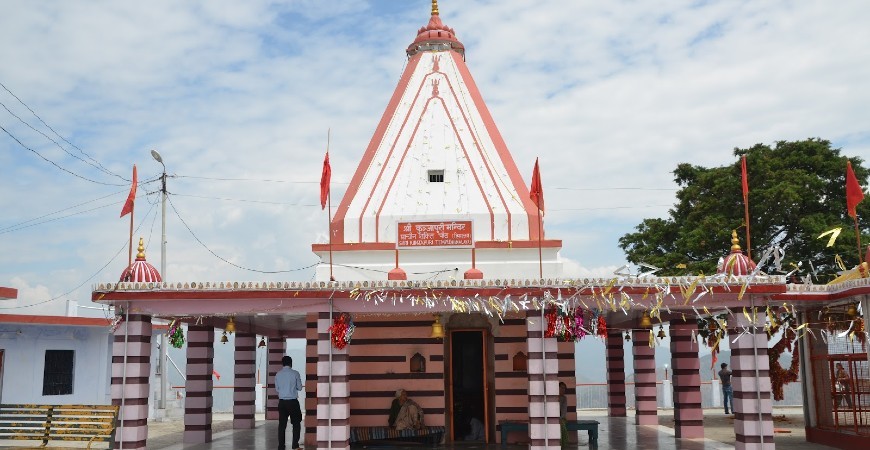
The temple is equally famous for its views. On clear mornings, the sun rises over a long line of snow-covered Himalayan peaks, including Swargarohini, Gangotri, Bandarpunch and Chaukhamba, while the valleys of the Ganga, Rishikesh and the Doon Valley spread out below.
The Kunjapuri Temple trek combines devotion and nature: a climb through forested hill slopes to a shrine where pilgrims have long come to worship, especially during Navratri.
Where Is Kunjapuri Temple Located?
Kunjapuri Temple stands on a peak near Hindolakhal village, above the town of Narendra Nagar in Tehri Garhwal district, Uttarakhand. It lies about 49 km from Rishikesh, along the hill road that runs from Rishikesh towards Narendra Nagar and Chamba.
From its high perch, the temple looks out over the Bhagirathi valley and the plains towards Rishikesh and Haridwar on one side, and the snow peaks of the Garhwal Himalaya on the other.
Kunjapuri Temple at a Glance
Fact |
Details |
Location |
Kunjapuri hill, near Hindolakhal, Tehri Garhwal district, Uttarakhand |
Distance from Rishikesh |
About 49 km |
Altitude |
About 1,676 m |
Deity |
Kunjapuri Devi, a form of Goddess Durga |
Significance |
Revered as a Shakti Peeth and Siddh Peeth |
Legend |
Believed to mark the place where the upper body of Goddess Sati fell |
Sacred triangle |
With Surkanda Devi and Chandrabadni temples in Tehri Garhwal |
Himalayan peaks in view |
Swargarohini, Gangotri, Bandarpunch and Chaukhamba |
Main festivals |
Navratri and Dussehra |
The Legend of Goddess Sati and the Shakti Peeths
According to Hindu tradition, Sati, the daughter of King Daksha and the wife of Lord Shiva, gave up her life at a yajna held by her father after he insulted Shiva. Overcome with grief, Shiva wandered the universe carrying her body.
To restore balance, Lord Vishnu divided Sati's body with his Sudarshana Chakra, and the places where its parts fell became sacred Shakti Peeths. At Kunjapuri, it is believed that the upper part of Sati's body, her chest, fell, making the hill a powerful seat of the Goddess.
The Sacred Triangle of Tehri Garhwal
Kunjapuri is one of three revered Siddh Peeths of the Goddess on hilltops in Tehri Garhwal district. Together with Surkanda Devi Temple near Dhanaulti, where Sati's head is believed to have fallen, and Chandrabadni Temple, it forms a sacred triangle for devotees of the Goddess. According to tradition, these shrines are associated with Adi Shankaracharya.
Kunjapuri Devi: The Deity of the Temple
The temple is dedicated to Kunjapuri Devi, a form of Goddess Durga, the Divine Mother. Devotees come from across Uttarakhand and beyond to seek her blessings, and the shrine is regarded as a Shakti Peeth in Uttarakhand of great importance.
Set on the very top of the hill, the temple complex is surrounded by open views on all sides, giving the shrine a quiet, elevated setting high above the valleys.
Sunrise at Kunjapuri: Views of the Himalayan Peaks
The Kunjapuri sunrise is one of the most celebrated in the Rishikesh region. As the first light reaches the hilltop, it slowly lights up the snow-covered ranges of the Garhwal Himalaya to the north.
- Swargarohini, a group of peaks in the Garhwal Himalaya.
- Gangotri, the peaks around the source region of the Bhagirathi.
- Bandarpunch, one of the prominent snow peaks of the western Garhwal Himalaya.
- Chaukhamba, the four-pillared massif of the Garhwal Himalaya.
The peaks are seen most clearly on cold, clear mornings, when the air is free of haze.
Views of the Valleys and the Ganga
Looking south, the hill offers wide views over the Bhagirathi valley, the Doon Valley and the plains towards Rishikesh and Haridwar. As the morning brightens, the valleys below come slowly into view beneath layers of hills.
The Kunjapuri Temple Trek
The traditional trek to Kunjapuri begins from Hindolakhal village, on the hill road above Narendra Nagar. The trail climbs through forested hill slopes, with views opening up over the Doon Valley and Rishikesh as you gain height.
A road also climbs close to the summit, and the final approach to the shrine is up a flight of steps to the temple at the top of the hill.
The Landscape Along the Trail
The Hindolakhal trek passes through the forested slopes of the lower Garhwal hills. The higher you climb, the wider the view, until the snow peaks to the north and the valleys to the south come into sight together at the summit.
Navratri at Kunjapuri Temple
Navratri at Kunjapuri is the temple's most important time of year. During the Navratri festivals, devotees come in large numbers to worship the Goddess, and special prayers are offered at the temple.
Dussehra is also celebrated at the temple, and the festival season brings a lively, devotional atmosphere to the hilltop.
Interesting Facts About Kunjapuri Temple
- Kunjapuri Temple stands at about 1,676 m above sea level.
- It is believed to mark the place where Goddess Sati's chest fell.
- It forms a sacred triangle with Surkanda Devi and Chandrabadni temples in Tehri Garhwal.
- On clear days, Swargarohini, Gangotri, Bandarpunch and Chaukhamba can be seen from the temple.
- It is one of the best-known sunrise points near Rishikesh.
- Navratri and Dussehra are its biggest festivals.
Best Time to Visit Kunjapuri Temple
Season |
Months |
Why visit or plan ahead |
Winter (best time) |
October to February |
Cool, clear weather and the sharpest views of the Himalayan peaks at sunrise; mornings at the hilltop are cold |
Summer |
March to June |
Warmer days in the valley, while the hilltop stays cooler than Rishikesh |
Monsoon |
July to September |
Rain and cloud can hide the peaks, but the hills are lush and green |
How to Reach Kunjapuri Temple
Mode |
How to reach |
By air |
Jolly Grant Airport in Dehradun is the nearest airport, with the rest of the journey by road via Rishikesh. |
By train |
Yog Nagari Rishikesh railway station is the nearest station, with Haridwar Junction a major railway hub nearby. |
By road |
Kunjapuri is about 49 km from Rishikesh by road, via Narendra Nagar on the hill road towards Chamba. Hindolakhal, the start of the traditional trek, lies on this road. |
Sterling Palm Bliss Rishikesh: A Riverside Base for Kunjapuri Temple
Sterling Palm Bliss Wellness Resort Rishikesh is about 36 km from Kunjapuri Temple, at Tapovan on the Badrinath Bypass Road.
This 2.5-acre wellness resort beside the Ganga has 35 rooms and suites, some with Ganga views, along with a full-service spa offering yoga, Ayurvedic therapies and Panchakarma. Dining options include the rooftop Italian restaurant Sky House and the vegetarian multi-cuisine restaurant Aroma by Taste, making it a restful base to return to after an early-morning visit to Kunjapuri.
Other Attractions

Trek to Swarg Ashram, Rishikesh
30 minsSwarg Ashram Rishikesh is a small spiritual township on the eastern bank of the Ganga, at the far end of the Ram Jhula suspension bridge. It is filled with ashrams, temples, ghats, meditation centres and quiet lanes, and is one of the best-known spiritual areas in Rishikesh.

Trek to Laxman Jhula, Rishikesh
40 MinsLaxman Jhula is a historic iron suspension bridge across the Ganga in Rishikesh, Uttarakhand, and one of the town's most recognisable landmarks. Built between 1927 and 1929 and opened to traffic in 1930, it stands at the place where, according to legend, Lakshmana, the younger brother of Lord Rama, crossed the river on a bridge of jute ropes.

Trek to the Beatles Ashram
34 minsThe Beatles Ashram Rishikesh is the former ashram of Maharishi Mahesh Yogi, officially known as Chaurasi Kutia. It became world-famous in 1968, when the four members of The Beatles came here to study meditation and wrote many of their best-known songs.

White Water Rafting in Rishikesh
3hrsWhite water rafting in Rishikesh is one of the most popular adventure experiences in India. Upstream of the town, the Ganga flows through a forested valley in the foothills of the Garhwal Himalaya, tumbling over a series of rapids that have made Rishikesh one of the country's best-known rafting destinations.

Bungee Jumping in Rishikesh
2hrsBungee jumping in Rishikesh is centred on Jumpin Heights, an extreme adventure site at Mohan Chatti in the hills near Rishikesh, Uttarakhand. Here, jumpers leap from a steel platform that juts out from a cliff, 83 metres above a rocky river gorge.

Adventure Activities in Rishikesh
3hrsRishikesh is known around the world as a centre of yoga and spirituality, but it is just as famous as the adventure capital of India. Set where the Ganga leaves the Himalayan foothills, the town is surrounded by fast rivers, sandy beaches, forested hills and rocky cliffs that make it a natural playground for outdoor sports.

Himalayan Treks from Rishikesh
3 to 14 daysRishikesh sits where the Ganga leaves the mountains, and for trekkers it is the doorway to the Garhwal Himalaya. From short forest walks to waterfalls and hilltop temples near the town, to multi-day Himalayan treks from Rishikesh that climb to snowy summits and alpine meadows, the region offers trails for every kind of walker.

Ayurvedic Spa in Rishikesh
3 to 14 daysAn Ayurvedic spa in Rishikesh brings together two of India's oldest traditions: Ayurveda, the classical Indian system of wellbeing, and the yoga and meditation that have made this Himalayan town famous around the world.